

Gaining control over burnout in ICT organisations
Information for participating organisations
RESEARCH DESIGN
Mental absence in the ICT sector: a study into underlying factors and risk areas
An integrated approach
The research design is based on an integrated approach, combining both quantitative and qualitative data. Quantitative measurements enable a systematic assessment of mental workload and related risk indicators. Data is collected using scientifically validated instruments, providing an objective view of workload levels across teams and organisations.
Aggregated analysis
A key component of the design is the aggregated analysis at organisational level. Individual data is coded and processed in a fully anonymous manner, ensuring reliable insights without traceability to individuals. These aggregated results form the foundation for organisation-wide interpretation and policy development.
Where required, additional in-depth analysis within the existing dataset can be conducted to support more refined interpretation and integrated understanding.
Sector benchmarking
To provide context, results are benchmarked against a broader sector dataset. This creates a meaningful reference framework, allowing organisations to position their outcomes within the dynamics of the ICT sector. This approach enables not only the identification of deviations, but also a more nuanced understanding of specific risk areas.
Qualitative data input
In addition to the quantitative analysis, participating organisations have the option to collect qualitative data, particularly within identified risk groups. This deeper layer of analysis focuses on understanding underlying causes, work context, and social dynamics.
Through structured reflective conversations, insight is gained into how employees experience their work and how they deal with pressure and workload. These conversations focus on clarifying personal goals and exploring individual solution pathways to reduce mental strain. This approach contributes to increased awareness of behavioural options and supports the development of individual resilience.
In collaboration with NLT Lab
This study is conducted in collaboration with NLT Lab, a specialist in psychosocial recovery care focused on mental overload and burnout. A total of 325 organisations within the ICT sector will be invited to participate.
Employees of participating organisations can enrol on a voluntary basis. Prior to participation, individuals are given access to a dedicated information page outlining the purpose of the study, the methodology, and safeguards related to data privacy and processing (informed consent).
Secure infrastructure
Upon registration, participants receive a personal link to the secure care environment of NLT Lab, where the questionnaires are administered. All data is processed within a highly secure infrastructure, in accordance with applicable privacy regulations, ensuring full anonymity and confidentiality.
RESEARCH METHODOLOGY
Early detection of mental overload and absence in the ICT sector: an integrated framework for detection and contextual interpretation
Introduction
Psychological absenteeism has increased significantly in recent years, with a rise of nearly 40% (ArboNed, 2026). At the same time, research indicates that a substantial proportion of IT professionals experience symptoms of burnout, with estimates reaching up to approximately 80%. It is important to note that these figures refer to experienced symptoms and should be distinguished from actual absence due to burnout.
Recent scientific insights highlight the importance of early detection of mental overload within organisations. This reflects a shift from reactive intervention to proactive identification. Central to this approach is the recognition of patterns in quantitative data, obtained through reliable and validated measurement instruments. These data provide insight into risk indicators and enable the timely identification of emerging issues.
At the same time, studies emphasise that quantitative measurement alone is insufficient to fully understand the phenomenon of burnout. Complementary qualitative data is required to uncover underlying causes, including work context, social dynamics, and individual experiences of workload. Interviews are explicitly identified as a valuable data source, as they provide insight into how employees perceive their work and manage pressure and stress.
The combination of quantitative and qualitative data therefore constitutes an integrated approach, in which early detection is combined with contextual understanding.
WFM Methodology
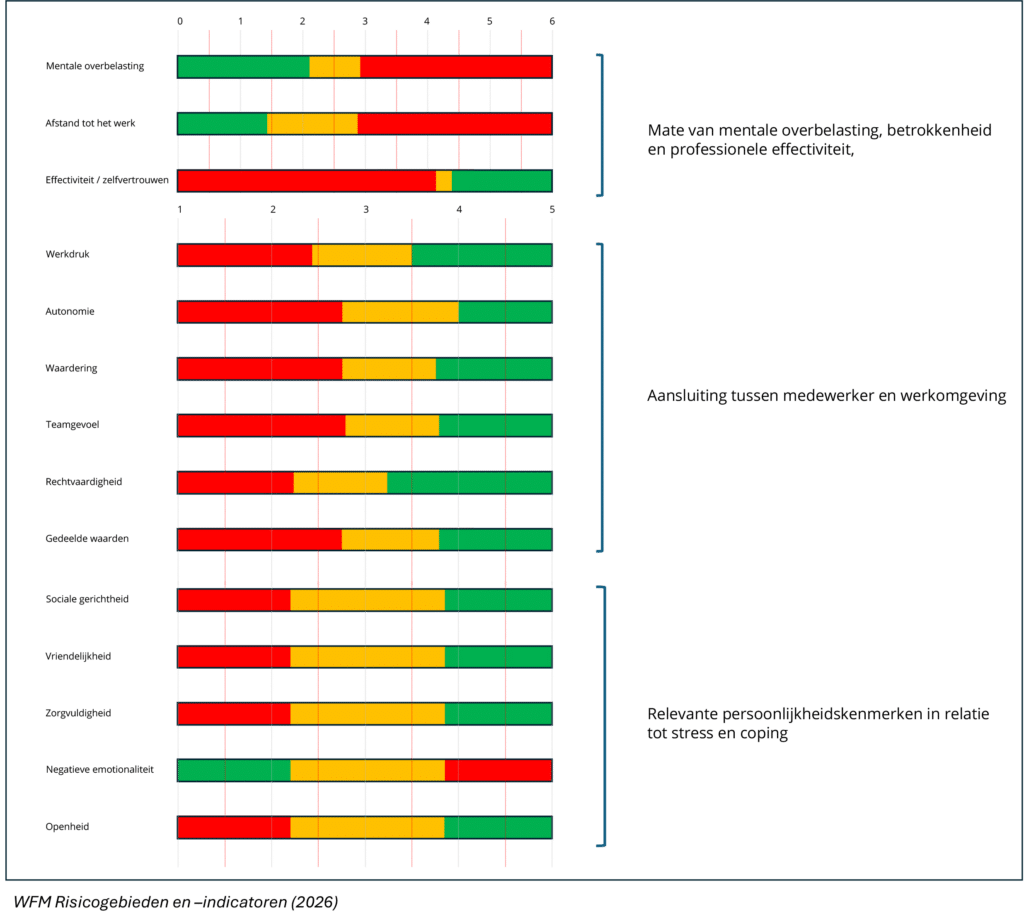
The measurement approach used in this study has been developed by WFM Research and is based on three scientifically validated instruments: the Maslach Burnout Inventory (MBI), the Areas of Worklife Survey (AWS), and the Big Five Inventory (BFI).
These instruments measure, respectively:
- levels of emotional exhaustion, engagement, and professional effectiveness
- the degree of alignment between the individual and the work environment
- personality traits relevant to stress and coping
By integrating these three perspectives, a coherent analytical framework is created that connects individual experience, organisational context, and personal predispositions. The strength of this approach lies in its ability to reveal underlying patterns and interactions that often remain hidden when measurements are used in isolation.
This integrative analysis makes it possible not only to identify where mental overload occurs, but also to understand why it arises and how it develops within specific teams or organisational units. The result is deeper insight that supports targeted interventions and timely action to prevent employee absence.
Core Principles
- The application of this framework is based on the following principles:
- Quantitative identification of risk indicators related to mental overload and absence
- Aggregated organisational-level analysis, ensuring data is combined in a secure and non-identifiable manner
- Benchmarking of results against relevant sector-wide data
- Collection of qualitative input within identified risk groups
- Systematic reporting of findings at both individual and organisational levels
- Initiation of reflective conversations within teams and between employees and management
- Development and implementation of targeted actions and follow-up measures
Organisations that respond to the invitation to participate in this study will be invited to a personal meeting, where the research framework and initial insights from the pilot phase will be discussed in more detail.
WFM Research
Keizersgracht 520
1017 EK Amsterdam
CONTACT
Telefoon: +31 20 894 25 67
Naar Contact
WFM Research is onderdeel van ELT Labs BV
KvK nr: 61219444
© WFM Research (2026). Alle rechten voorbehouden.